
Who Was Buckminster Fuller?
Carbon-60's proper name — buckminsterfullerene — honours Richard Buckminster Fuller (1895–1983): an American architect, engineer, inventor, designer, author and futurist whose lifelong obsession was doing "more with less." He is remembered above all for the geodesic dome, and the C60 molecule was named after him because its shape is, in effect, a geodesic dome closed into a perfect sphere.
A rocky start
Born in Milton, Massachusetts in 1895 into an old New England family, Fuller entered Harvard as a legacy student — and was expelled twice, once for spending his tuition entertaining a dance troupe. He never earned a degree. He found his footing instead in the U.S. Navy during the First World War, where a knack for practical engineering emerged: he devised a winch system to rescue pilots from downed seaplanes, which won him a posting to the Naval Academy at Annapolis.
The turning point
By his early thirties Fuller had suffered the death of his young daughter and the collapse of a construction business, and had reached a profound personal crisis. Rather than give up, in 1927 he resolved to spend the rest of his life on a single experiment: to discover what one ordinary individual could do to benefit humanity that governments and large institutions could not. Everything he became flowed from that decision.
The Dymaxion years
Fuller poured that resolve into radical designs, most branded with his coined word "Dymaxion." The Dymaxion House was a lightweight, mass-producible round dwelling hung from a central mast. The Dymaxion Car was a streamlined, three-wheeled vehicle that could carry eleven passengers. And the Dymaxion Map (patented 1946) unfolded the globe onto a flat surface with almost no distortion of the continents' relative size or shape — a genuinely new way of seeing the whole Earth at once.
The geodesic dome
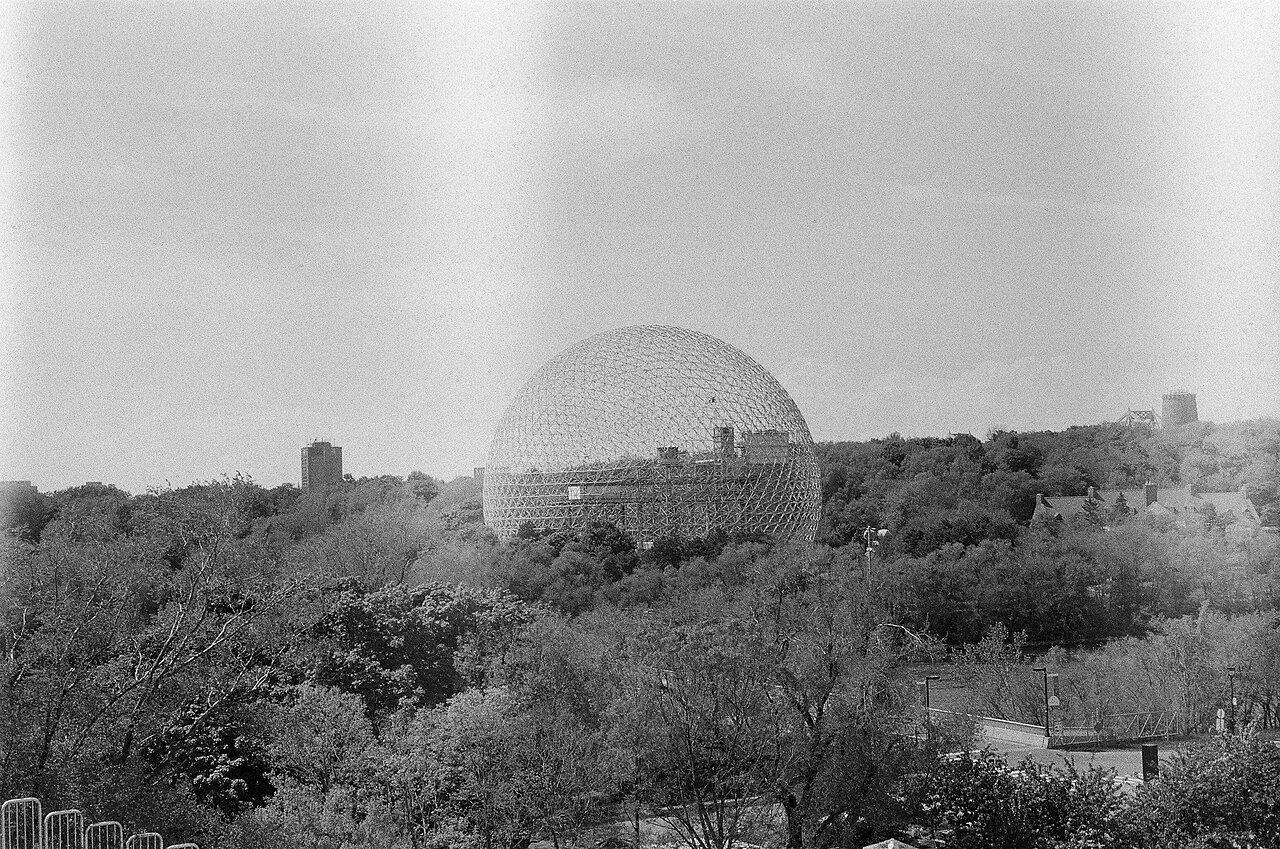
His masterwork was the geodesic dome — a sphere assembled from a lattice of triangles that grows stronger, not weaker, as it gets larger, enclosing the most space with the least material. He received the U.S. patent in 1954, and today there are more than 300,000 geodesic domes worldwide, from Arctic radar stations to playground climbers to his celebrated Montreal Biosphère, built for Expo 67 (pictured above). It was exactly this geometry — points arranged over pentagons and hexagons into a sphere — that scientists recognised in the C60 molecule in 1985.
A thinker who reshaped language
Fuller wrote more than 30 books and was awarded 28 U.S. patents and dozens of honorary doctorates. He coined or popularised a vocabulary still in use today: "Spaceship Earth" (the idea that our planet is a single finite vessel we all share and must steward), "ephemeralization" (doing ever more with ever less), "synergetics," and "tensegrity." He taught and lectured at Harvard and MIT and, from the late 1950s, was a professor at Southern Illinois University — where, fittingly, he and his wife lived in a geodesic dome.
Why the molecule bears his name
When Harold Kroto, Robert Curl and Richard Smalley produced a startlingly stable 60-carbon molecule in 1985, its soccer-ball cage of pentagons and hexagons was unmistakably the geometry of Fuller's domes. They named it buckminsterfullerene in his honour — a discovery that would earn them the 1996 Nobel Prize in Chemistry and establish C60 as a carbon allotrope. Fuller had died two years before the molecule was found, but his name now belongs to chemistry as firmly as it belongs to architecture.
Sources: Encyclopaedia Britannica; Buckminster Fuller Institute; American Chemical Society. Dome photo: Maela Ohana, Wikimedia Commons, CC BY 4.0.